

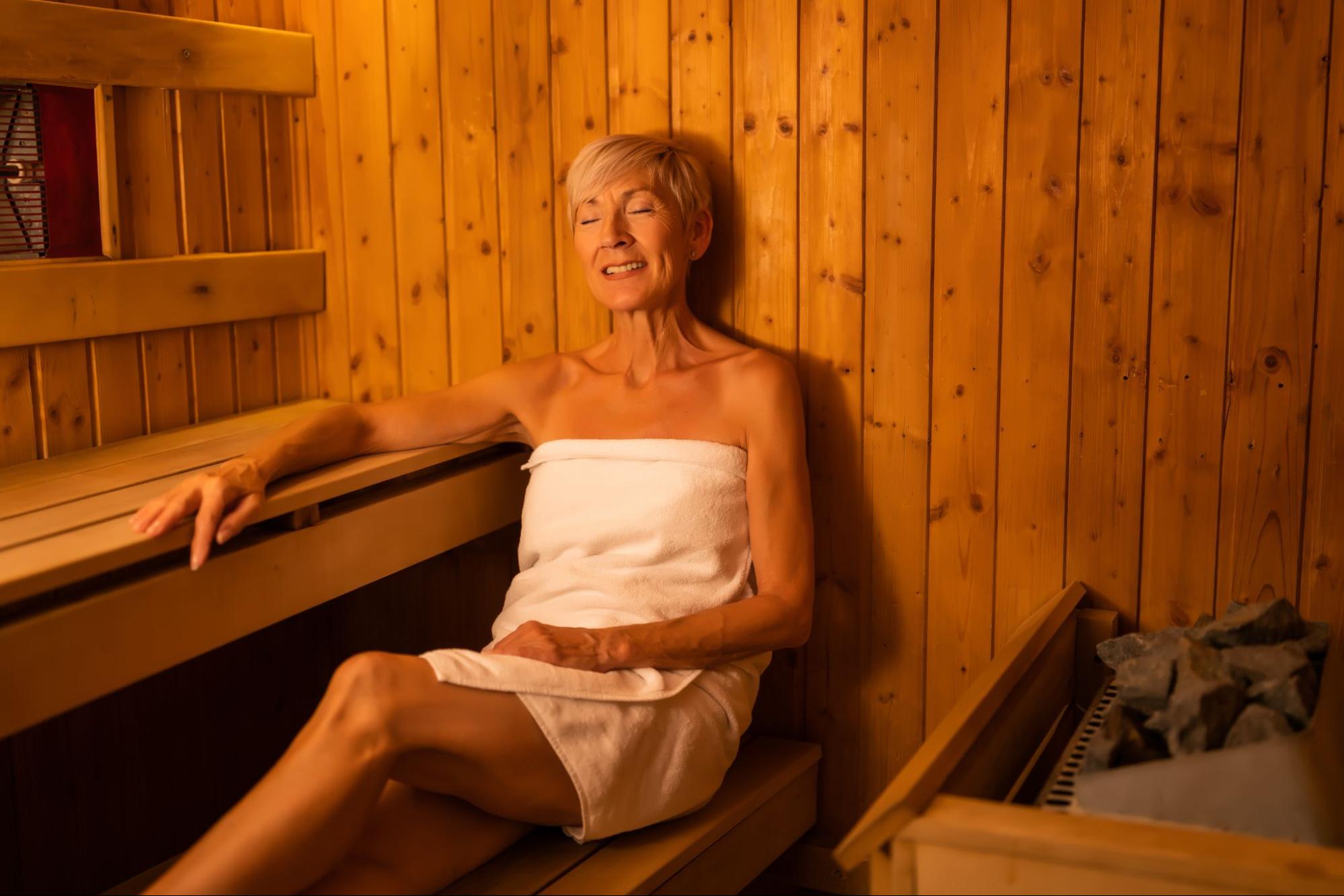
An infrared sauna is a heat cabin where infrared emitters directly and deeply warm the body, promoting circulation, relieving tension, and allowing for pleasant, deep-acting relaxation without the need to heat the entire room.
Traditional saunas and infrared cabins use different methods of heat transfer: In a traditional sauna, hot air is generated at high temperature and low humidity by heating stones and pouring water over them. This causes intense sweating and leaves a refreshing feeling. In contrast, an infrared sauna heats the body directly and more deeply, without significantly heating the surrounding air. This leads to a gentle but equally effective heat experience.
A comparison of the advantages and disadvantages of saunas reveals the central difference: infrared saunas heat the body directly and penetrate deeper into the tissue, which can stimulate blood circulation and support the treatment of inflammation. Traditional saunas, on the other hand, generate a more intense, humid heat that allows for intense sweating and more thorough skin cleansing.
Infrared saunas operate at lower temperatures, which many find more pleasant. However, they do not offer the humid heat typical of a traditional sauna. The latter, in turn, reaches higher temperatures and humidity, thus promoting particularly deep skin cleansing, but requires more energy and time to heat up.

What is an infrared sauna?
An infrared sauna, also known as an infrared cabin, is a modern form of sauna that works with infrared radiation. Unlike traditional saunas, which heat the air around the body, an infrared sauna heats the body directly from within, as the heat penetrates deep into the skin layers. This leads to intense sweating without the need for extremely high temperatures. As a result, the health benefits can be experienced at lower temperatures, which is more pleasant and safer for people who do not tolerate high heat well.
Features of infrared saunas
There are different types of infrared cabins, which differ in the wavelength of the infrared radiation and offer different therapeutic effects depending on the user's needs. In contrast to what one would expect from a normal sauna, infrared cabins offer a different form of heating that acts directly on the body. Below, we present the most important types of infrared saunas as well as their unique characteristics and benefits.
Types of infrared saunas:
1. Far-infrared sauna (FIR)
A far-infrared sauna emits longer infrared waves that penetrate less deeply into the body's tissue and reach the upper layers of the skin. FIR saunas generate infrared radiation at the end of the spectrum with wavelengths in the range of 3,000 to 100,000 nm*. Due to this penetration, the FIR sauna is particularly effective in detoxifying the body. A stay in an infrared cabin of this type ensures that the heat generated by the long infrared waves can mobilize toxins deposited in the fats, which are then excreted from the body through intense sweating. Regular sessions in an FIR sauna can also help reduce inflammation and muscle pain, which can be particularly beneficial for people with elevated inflammation levels. In addition, the far-infrared sauna promotes blood circulation, which supports tissue regeneration and general cardiovascular health.1 Due to these benefits and ease of use, FIR saunas are most commonly found in home installations and are a popular choice for people who appreciate intense sweating without the need for high temperatures.
2. Near-infrared sauna (NIR)
A near-infrared sauna uses shorter but more intense infrared waves with wavelengths in the range of 700 nm to 1,400 nm*, which penetrate deeper into the body.
NIR waves are often used in aesthetic medicine because their effect can promote collagen production, which is crucial for healthy and youthful-looking skin. Collagen stimulation helps improve skin elasticity, reduce wrinkles, and regenerate skin damage such as scars or pigment spots.2
In addition, an NIR sauna can support the wound healing process and relieve acne symptoms. Near-infrared saunas are often used in combination with other therapeutic technologies to enhance the healing and regenerative effects. Therefore, they are often chosen by individuals seeking benefits in skin care and anti-aging therapy.
3. Full-spectrum infrared sauna
The full-spectrum infrared sauna combines far (FIR), mid (MIR), and near-infrared (NIR) radiation, thus utilizing a comprehensive spectrum* of wavelengths that offers various health benefits. The mid-infrared range (MIR) is between 1400 and 3000 nm and complements the deep heating effect of near-infrared radiation and the gentle heating of far-infrared. This combination stimulates profound detoxification processes and supports the regeneration of skin and muscles.
Full-spectrum emitters offer versatile heat therapy that includes both deep tissue heating (by NIR) and superficial positive effects on the skin (by FIR). These saunas are ideal for people who want to improve skin health while supporting the body's regeneration and natural detoxification processes.
Full-spectrum infrared saunas are particularly popular with people who seek holistic therapy and want to utilize all the benefits of the different types of infrared waves in one device. Some models even allow individual adjustment of the intensity of the wavelengths, so that sessions can be perfectly tailored to health needs and personal preferences.
*The infrared spectrum refers to the range of infrared wavelengths used in infrared saunas. Depending on the wavelength, different parts of the spectrum can uniquely affect the body, from promoting sweating to stimulating cell regeneration.
Additional features of infrared saunas
Infrared saunas work with various wavelengths and thus offer numerous functions that further enhance their health benefits and comfort.
A portable infrared sauna is a compact device that can be easily set up anywhere in the house. It is perfect for anyone who wants to enjoy the benefits of heat therapy without having to purchase a permanently installed sauna. Such saunas are often equipped with infrared emitters that generate the appropriate wavelengths, thereby heating the sauna and providing a constant, gentle heat source.
A key advantage of infrared saunas is thermoregulation – the body's ability to respond to temperature changes. This leads to sweating, which stimulates natural detoxification. Infrared saunas gently heat the body, allowing for effective detoxification without requiring extremely high temperatures.
In our infrared saunas, we use ecologically certified Okume wood, a sustainable and extremely hard wood that is wonderfully suited for sauna construction, Canadian cedar wood of the highest quality, and hypoallergenic Nordic spruce of "A" quality. Cedar wood is valued for its durability, natural antibacterial properties, and pleasant scent, which contributes to a relaxing atmosphere in the sauna. Nordic spruce, as a hypoallergenic wood, is an excellent choice for people with allergies or sensitive skin.
Home saunas are becoming increasingly popular as they allow the use of heat and light therapy in the comfortable conditions of one's own home.

What is a traditional sauna?
A traditional sauna, also known as a Finnish sauna, is a type of sauna in which heat is generated by heating air using special ovens or heating stones. Unlike infrared saunas, which directly heat the user's body, traditional saunas increase the air temperature, leading to intense sweating and deep relaxation.
Characteristics of traditional saunas
Traditional saunas are characterized by dry heat generated by the operation of ovens. They often have a wooden interior design, made from high-quality woods such as pine or cedar, to better retain heat. Ventilation also plays an important role, ensuring air circulation and controlling humidity levels to create the right environment within the sauna.
A sauna visit offers a unique climate that combines high temperatures with traditional practices such as pouring water over hot stones. This process briefly increases humidity and intensifies the sensation of heat – for many, an indispensable part of the sauna experience. Especially in the sweating room, this ritual contributes to the therapeutic effect. The intense heat of a traditional sauna can relax muscles and promote deep recovery, which is particularly appreciated by people who prefer higher temperatures and classic relaxation methods. Both Finnish saunas and modern variants offer specific advantages, tailored to different preferences and health needs.
What are the differences between an infrared sauna and a traditional sauna?
Infrared saunas and traditional saunas differ in many aspects, such as health benefits, safety, acquisition and operating costs, user experience, and installation requirements. The type of heat generation and distribution also differs, as do maintenance and durability. Another important factor in choosing the right sauna is the respective environmental impacts, which also vary and can play an important role in decision-making.
In the following, we will discuss each of these aspects in detail to give you a better understanding of which type of sauna best suits your individual needs and preferences.
Health differences between infrared sauna and traditional sauna
The health benefits of traditional saunas mainly consist of improved blood circulation, strengthened immune system, reduction of stress and muscle tension, and pain relief.3
The infrared sauna directly heats the body through infrared radiation, allowing the heat to penetrate deeper into the tissue. This technology offers additional benefits such as deep body detoxification, accelerated muscle regeneration, relief of chronic pain, improved skin elasticity, support of the lymphatic system, and reduction of inflammation (2). Here, the advantage of the infrared cabin lies in the targeted heating of the body, which can be particularly beneficial for people with health problems.
Safety differences between an infrared sauna and a traditional sauna
Temperature control: Infrared saunas operate at lower temperatures, making them particularly pleasant for people who are sensitive to high heat. The heat is transferred directly to the body, so users can more easily control the intensity of the heat and avoid overheating. In traditional saunas, on the other hand, the air is heated to temperatures between 80 and 90°C. Here, it is important to regularly monitor the temperature and adjust the humidity if necessary to minimize the risk of overheating or burns and to protect the cardiovascular system.
Risk minimization: For people with health challenges, the duration of the sauna session is particularly important. In infrared saunas, thanks to the lower temperatures, you can stay longer without a high risk of overheating – ideal for people who tolerate heat poorly. Nevertheless, for both types of saunas, it is important to consider the session duration to avoid health risks such as dehydration or an overload of the cardiovascular system.
Fire protection and electrical safety: Traditional saunas, especially those heated with wood, pose a higher risk of fire, which requires special attention during installation and operation to ensure safety. It is also important to regularly check the technical condition of the stove and electrical systems in both types of saunas to minimize the risk of fires or electric shocks.
Infrared saunas use infrared emitters and generate dry heat. With quality infrared saunas, the risk of fire is low, as ideally the RCD (residual current device) trips in the event of a defective emitter.
Price differences between infrared sauna and traditional sauna
Acquisition costs: Infrared saunas are generally cheaper to acquire and install than traditional saunas. Most infrared cabins come as easy-to-assemble kits that can be set up quickly and easily connected to a standard power outlet. A high-quality infrared cabin for 1-2 people usually costs between €5,500 and €8,000, while premium models for traditional saunas often start at at least €15,000.
Additionally, a traditional sauna requires professional installation, which includes, among other things, the expert installation of the stove, special electrical connections, and often an exhaust air solution – which significantly increases the total cost. Infrared saunas therefore offer a more economical and practical solution that still brings many health benefits.
Due to a plug-and-play principle, infrared saunas can also be dismantled and taken along in the event of a possible move. Traditional saunas are usually permanently installed and make dismantling for a possible move more difficult.
{{ad-banner-2}}
Operating costs: The operation of an infrared cabin is extremely economical in terms of energy consumption. On average, it costs about €0.70 for smaller models. Traditional saunas and steam baths consume significantly more energy, as they have to heat the stones to high temperatures and usually have to remain switched on longer to achieve the desired conditions. Furthermore, heavy current is often used here to reach corresponding air temperatures.
With three sessions per week, the operating costs of an infrared cabin are €2.10, while these can be many times higher for a traditional sauna. This shows that using an infrared cabin is a more cost-effective option for those who want to relax regularly in an infrared cabin.
Differences in user experience between infrared sauna and traditional sauna
Ease of use: Infrared saunas and traditional saunas are similarly easy to use.
Due to the lower temperatures, which are between 40 and 65°C, sessions in infrared saunas are more pleasant and gentle for most users, including those who are sensitive to high temperatures, and well tolerated. The shorter heating time and the possibility of using the sauna without intense sweating make the sessions less physically strenuous. Traditional saunas, operated at higher temperatures (over 80°C), can be more difficult for some people to manage, especially during longer sessions.
Personalization: Infrared saunas offer greater flexibility in setting up the heat cabin. Users can easily regulate the temperature and, in some models, also set the session duration, allowing for a more individual experience when going to the sauna. In traditional saunas, it is possible to regulate the temperature by controlling the intensity of the stove and pouring water over hot stones, but humidity is more difficult to control precisely, which can impair the comfort of use when going to the sauna.

Differences in installation between an infrared sauna and a traditional sauna
Construction: The installation of an infrared sauna is practically always easier and less complex than that of a traditional sauna. Infrared saunas are often available as kits that can be assembled without professional help and only require a standard power outlet. Traditional saunas, on the other hand, require more complex assembly, including the installation of a stove, a powerful power connection, and suitable drainage and ventilation.
Space requirements: Traditional saunas require more space and a higher ceiling, as well as effective ventilation to prevent moisture problems. Infrared saunas are more compact, require less space and ventilation, making them better suited for installation in smaller living spaces. The smallest infrared saunas usually only need 1 square meter.
Portability: Infrared saunas are more mobile and easier to transport, thanks to their lightweight construction and simple disassembly. Traditional saunas, on the other hand, are less mobile and harder to move, as they have larger dimensions and heavier materials.
Heating and heat in infrared cabins and traditional saunas
Heating mechanism: Traditional saunas use a stove that heats stones and is doused with water to create steam and increase the air temperature, which causes intense sweating. Infrared saunas generate heat through infrared waves that directly warm the body without heating the air.
Heat distribution: In traditional saunas, heat is evenly distributed by hot air, warming the entire body uniformly. In infrared saunas, infrared rays penetrate deeper into the skin and tissue, providing more targeted warming. This makes infrared saunas more effective at warming the body without the need to heat large volumes of air.
Temperature variability: Traditional saunas, such as the Finnish sauna, reach higher temperatures, usually above 80°C, which can be too intense for some people. Normal saunas differ significantly from infrared saunas, which operate at lower temperatures, typically between 40 and 65°C. This offers a more pleasant experience and is better suited for individuals who are sensitive to heat. Not having to compromise anything with an infrared cabin means that even at lower temperatures, the body sweats sufficiently and the desired health benefits are achieved.
Humidity: Traditional saunas use water vapor to increase humidity and temperature in the room, which can be beneficial for individuals who prefer intense sweating and skin cleansing. Infrared saunas offer dry heat without humidity, which is more comfortable and less strenuous for the body, especially for people who do not tolerate high humidity well.
Differences in maintenance and lifespan between infrared cabins and traditional saunas
Maintenance: Infrared saunas and traditional saunas are generally easy to maintain. Infrared saunas only require regular cleaning of surfaces, without the need for frequent part replacement.
Traditional saunas may require more attention – the stove and stones must be cleaned regularly and possibly replaced, and wooden parts are at risk of needing repair or replacement due to high humidity and temperature. Besides the materials used, this is also a question of the intensity and frequency of use.
Durability: Both infrared saunas and traditional saunas have a long lifespan, provided they are properly maintained and of good quality. Depending on the quality of the infrared emitters, they can last for many years. For example, our carbon-ceramic emitters have an average operating life of 30,000 hours. Traditional Finnish saunas made of high-quality wood can last for decades but are more susceptible to damage from moisture and temperature. If necessary, the wood can be sanded, the sauna stones replaced, or in the worst-case scenario, the stove replaced.
Differences in environmental impact between an infrared sauna and a traditional sauna
Energy efficiency: Infrared saunas are significantly more energy-efficient than traditional saunas. They consume less energy because they heat the body directly, rather than heating the air around the user. This results in lower energy consumption, leading to a smaller carbon footprint and allowing for more environmentally friendly sauna use.
Ecological footprint: It is not possible to make a blanket qualitative statement about sustainability or the ecological footprint here. For a qualitative statement, the choice of wood, production location, longevity, and frequency of use must be considered.
However, it is a fact that infrared saunas consume less electricity in absolute terms and likely have a more positive ecological balance (depending on the type of electricity generation).

Which is better: infrared or traditional saunas?
The decision between an infrared cabin and a traditional sauna largely depends on personal preferences and individual needs, as both offer unique advantages.
The infrared cabin operates at lower temperatures (40°C to 65°C), making longer sauna sessions particularly pleasant – ideal for people who are sensitive to high heat. It is easy to use and provides a gentle heat treatment that penetrates deep into the skin and tissue. However, it lacks the intense heat and sweating experience that many sauna enthusiasts appreciate.
Traditional saunas, on the other hand, offer the classic sauna experience with temperatures from 70°C to 100°C and the possibility of generating steam. This intensifies sweating and promotes deep relaxation. They offer a particularly thorough cleansing and a more comprehensive heat experience, but are also more energy-intensive, require longer heating times, and are often more expensive to install and maintain.
What are the advantages of an infrared cabin compared to a classic sauna?
Compared to saunas and infrared cabins, there are some specific advantages of infrared cabins.
- Lower operating temperatures, making longer stays in the infrared cabin more pleasant
- Direct heat penetration deep into muscles and tissues for strong therapeutic effects
- Improved detoxification through the effect of infrared heat
- Sustainable and intensive warming of the body
- Energy efficiency, as less electricity is needed to achieve the desired effects
- Faster heating times, which reduces waiting times before use
- Easy installation, often without the need for plumbing or extensive electrical work
- Generally lower acquisition and maintenance costs
- Ability to promote targeted health benefits such as pain relief, deep heat, and improved circulation.
What are the advantages of a traditional sauna compared to an infrared sauna?
- Higher heat levels for a more intense sweating experience
- Steam option for increased humidity and better breathing
- Improved relaxation through the combination of high heat and steam
Whether the mild, deeply penetrating heat of an infrared sauna or the intense, traditional heat of a Finnish sauna is better for you depends entirely on your personal preferences and health goals. Both options have their particular appeal and can offer different positive effects on well-being depending on your needs.
____
Sources:
1. Beever, Richard, MD CCFP CI. "Far-infrared saunas for treatment of cardiovascular risk factors: Summary of published evidence." *Canadian Family Physician* 55, no. 7 (2009): 691-696. PMCID: PMC2718593. PMID: 19602651. Available in English and French.
2. Hu, Di, Moalem-Taylor, Gila, and Potas, Jason R. "Red-Light (670 nm) Therapy Reduces Mechanical Sensitivity and Neuronal Cell Death, and Alters Glial Responses after Spinal Cord Injury in Rats." *Published online* October 15, 2020. doi: 10.1089/neu.2020.7066. PMCID: PMC7585617. PMID: 32552352.
3. Hussain, Joy and Marc Cohen. "Clinical Effects of Regular Dry Sauna Bathing: A Systematic Review." PMCID: PMC5941775, PMID: 29849692.





Share:
Can a sauna and infrared cabin help with stress?
How an infrared sauna can help you with a cold