

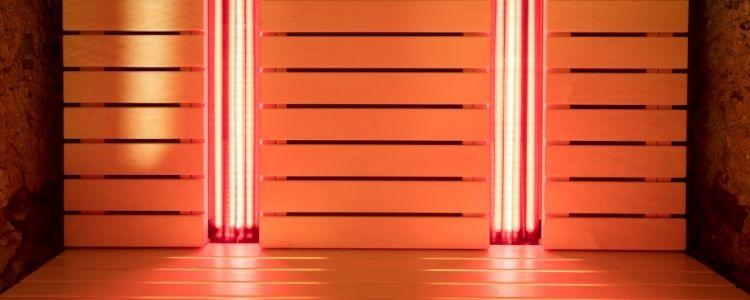
Ceramic heaters are well suited for infrared cabins. They emit far-infrared light, which the human body can absorb particularly well.
In a Finnish sauna, a high air temperature is reached, which is often perceived as strenuous. In infrared saunas, the air does not heat up as much because the infrared radiation is absorbed directly by the body.
This heats the body from the inside, which is more pleasant and has the same, if not a better, effect than a traditional Finnish sauna.
Classification of infrared radiation
Electromagnetic waves with a wavelength of 780 nm to 1 mm are referred to as infrared radiation. This directly follows the red end of the visible light spectrum.
There are two ways to classify the infrared spectrum:
- into near, mid, and far-infrared light (NIR, MIR, and FIR)
- into infrared A, B, and C (IR-A, IR-B, and IR-C)
Although both classifications divide infrared light into three ranges, these ranges do not correspond to each other.
Near-infrared light (NIR) consists of IR-A and IR-B. Mid (MIR) and far (FIR) infrared light are grouped together as IR-C.
Wavelength and heater temperature are inversely proportional. The hotter the surface of the heater, the shorter the wavelength of the emitted infrared radiation.
In other words, to generate short-wave infrared light, the heater must be significantly hotter than when generating long-wave infrared light.
Spot heaters and surface heaters
Infrared heaters are distinguished between surface heaters and spot or rod heaters.
In surface heaters, infrared radiation, i.e., heat, emanates from a surface. The advantage is that large parts of the body are simultaneously exposed to uniform radiant heat.
Surface heaters emit long-wave infrared radiation. Examples of surface heaters include carbon heaters and magnesium heaters.
Spot or rod heaters emit infrared rays only selectively. This means that you have to position yourself in front of the heater so that the infrared heat directly hits the desired part of the body.
Spot heaters emit medium and long-wave infrared light. Ceramic heaters are among the spot heaters.
What are ceramic heaters for infrared cabins?
As mentioned, ceramic heaters are spot heaters. The current-conducting heating elements are surrounded by ceramic material. This material does not conduct electricity and thus acts as an insulator.
The heat transferred from the heating element to the ceramic is emitted from the ceramic surface as long-wave infrared radiation. This is perceived as pleasant and heats the body from within.
The radiation emission is high, meaning that a high percentage of the supplied energy is emitted as long-wave infrared heat.
However, the surface of the heaters becomes very hot, which is why they must be installed with touch protection. Therefore, it is not possible to install ceramic heaters on all four walls and under the bench of the infrared cabin.
The medical effects of ceramic heaters
The human body consists of an average of 70% water. Far-infrared radiation penetrates up to 4 cm deep into the skin, interacts with water molecules, and is therefore particularly well absorbed by the body.
Far-infrared radiation has many positive effects on health and well-being. Here are some examples:
- Staying in the warmth of the infrared cabin relaxes and reduces stress.
- The heart pumps better, circulation is stimulated, and blood pressure decreases.
- Blood circulation is increased, and you sweat. This has similar effects to a workout.
- Muscle tension and joint pain are relieved.
- Weight loss is facilitated.
- Skin becomes firmer and more radiant, and cellulite is reduced.
You can read more here.
The power and temperature of the heating element in ceramic heaters
The heating element of a ceramic heater usually has a power of 300 watts. However, there are also ceramic heaters with powers between 200 and 350 watts.
A large proportion of the energy supplied as electricity is converted into heat, meaning ceramic heaters are very efficient. The infrared radiation is in the long-wave range and is emitted selectively (not across a surface).
The temperature of the heating element is very high, which is why safety precautions must be observed when installing ceramic heaters.
Since the heat of the heating element is transferred to the ceramic, it is protected from overheating, which extends its lifespan.
The difference between ceramic heaters and other infrared heaters
Ceramic heaters are just one type of infrared heater. There are also full-spectrum heaters, magnesium heaters, and carbon heaters.
In addition, Clearlight offers a special feature: the True Wave II™ Far Infrared Heater is the only hybrid carbon and ceramic heater on the market (more on this below).
But first, let's explain the characteristics and differences of the various types of infrared heaters.
Ceramic heaters or full-spectrum heaters
Full-spectrum heaters generate long-wave, mid-wave, and short-wave infrared radiation—the full infrared spectrum. All Clearlight Sanctuary sauna models are equipped with True Wave™ full-spectrum heaters. These emit one-third near-infrared, one-third mid-infrared, and one-third far-infrared radiation each.
Ceramic heaters, on the other hand, only emit far-infrared light. The radiation emission is high for both types of heaters. A disadvantage of ceramic heaters is that their surface temperatures can become very high, so protective measures must be taken. The heaters must not come into contact with the skin and must be securely installed.
Therefore, it is not possible to equip an infrared cabin all around with ceramic heaters.
Ceramic heaters or magnesium heaters
Magnesium heaters contain tubes made of a special stainless steel that is particularly heat-resistant.
At the center of the stainless steel tubes are heating rods surrounded by magnesium oxide. This has an insulating function and is intended to prevent contact between the heating rod and the stainless steel tube. The magnesium oxide can store heat well and therefore constantly emit infrared radiation.
The emitted infrared radiation is mainly long-wave and also has a small mid-wave component.
In contrast to ceramic heaters, magnesium heaters are surface heaters, meaning they can emit infrared light over larger areas, allowing for more uniform irradiation of the body.
An aluminum reflector ensures effective distribution of the infrared rays.
Carbon heaters or ceramic heaters
Carbon heaters also have flat heating panels. These are made of carbon and only emit long-wave infrared light.
A major advantage of carbon heaters is that their surface temperature is so low that they can be touched safely. However, they emit little radiation, so they are not very efficient.
The Clearlight True Wave II™ Far-Infrared Heaters with their unique hybrid carbon-ceramic technology
Which is better: a carbon heater or a ceramic heater?
You no longer have to ask yourself this question, because after years of research, Clearlight has developed the True Wave II™ Far-Infrared Heater.
This is the only carbon-ceramic hybrid infrared heater on the market. It consists of microscopically thin carbon fibers connected with our patented micro-fine ceramic in a special process.
The carbon component ensures that long-wave infrared light is generated. This penetrates deep into the skin and is well absorbed by the body.
The ceramic component ensures that more infrared radiation is emitted, thus increasing the efficiency of the heater.
The surface temperature of the heaters is low, so they can be installed all around the infrared cabin and optimally irradiate the body from all sides. This effectively raises the body's core temperature.
Conclusion
Anyone purchasing an infrared cabin can choose between different infrared heaters. These differ, among other things, in the emitted wavelength range, the surface temperature of the heating elements, energy efficiency, and whether they emit radiation selectively or over a surface.
Most heaters primarily or exclusively produce long-wave infrared light. This is well absorbed by the body and heats it from the inside, while the air temperature in the infrared sauna remains in a comfortable range.
Full-spectrum heaters emit short, mid, and long-wave infrared light, so the user can benefit from the different effects of the various infrared wavelengths.
Spot heaters emit infrared radiation selectively, allowing for targeted irradiation of a specific body part.
Surface heaters, on the other hand, irradiate the entire body evenly.
The shorter the wavelength of the generated infrared radiation, the hotter the heating element must be. To avoid burns from accidental contact, such heaters must be safely installed, which limits the possibilities for installation in the infrared cabin.
Carbon heaters and hybrid carbon-ceramic heaters have a low surface temperature and can be touched without problems.
However, carbon heaters have low energy efficiency, and their radiation emission is lower than that of other heater types.
The hybrid carbon-ceramic heater developed by Clearlight (True Wave II™ Far-Infrared Heater) is the only one that combines long-wave infrared radiation, low surface temperature, and high radiation emission.
Medical Sources
https://www.ncbi.nlm.nih.gov/pmc/articles/PMC4493260/
https://www.ncbi.nlm.nih.gov/pmc/articles/PMC3699878/
https://www.ncbi.nlm.nih.gov/pmc/articles/PMC2718593/
https://pubmed.ncbi.nlm.nih.gov/18685882/





Share:
Can a sauna and infrared cabin help with stress?
How an infrared sauna can help you with a cold