

![Farblicht [Bedeutung & Wirkung von Farben]](http://clearlightsaunas.co/cdn/shop/articles/65c5a22c620b17e5c01872de_Clearlight-saunas-Hero.jpg?v=1739111537&width=2700)
It has been known for millennia that colors affect the human body, mind, and psyche. Early civilizations in India, Egypt, Greece, and China already used colored light [1,2]. Chromotherapy, as color therapy is also known, has been part of healing arts since around 2000 BCE [2].
Colored light or "chromotherapy" uses electromagnetic waves in the visible spectrum [3], i.e., with wavelengths of approximately 380-780 nm [4], to achieve positive effects on health and well-being. This light, visible to humans, is divided into spectral colors.
The light of each color has a defined wavelength, frequency, and energy [2]. These properties influence the body, psyche, and mind [5], and each color has specific effects.
The light particles (photons) are absorbed by specific molecules in the cells, leading to chemical changes [6]. Thus, color lamps can achieve a wide variety of effects.
What colored light can – and cannot – do
Colored light is counted among alternative, non-conventional medical procedures. These alternative applications are often not recognized by science.
The reason for this is that many of the effects are not based on hard scientific facts [7]. This is partly because colors often have subtle effects on the psyche, among other things, which are subjective and difficult to quantify, making them hard to compare and reproduce [5].
The effect of colors varies individually and depends on age, gender, cultural background, and personal taste, among other factors [6,7].
Contrary to some promises, colored light alone cannot cure specific, possibly serious, illnesses. Colored light and colored light lamps are complementary measures that can support, but never replace, conventional medical therapies.
Please discuss all medical measures with your doctor and follow their recommendations!
However, dismissing colored light as a purely esoteric wellness measure is equally unjustified. Although it is often claimed that the effects of colors on humans cannot be scientifically proven, there are studies that do indeed demonstrate these effects.
Health and illness, well-being and unpleasant sensations, psyche and body are always interconnected and should be viewed as a whole. Similarly, conventional and alternative measures, including color light therapy, should not exclude each other but rather complement one another.
The effect of colored light on the body, psyche, and mind
These three areas are essentially inseparable. A physical illness often affects mental state and cognitive abilities, just as psychological or psychiatric illnesses can have organic causes.
For clarity, however, we will discuss these three areas separately below.
The effects of colored light on the body
Electromagnetic radiation in the visible light spectrum primarily affects enzymes and mitochondria in cells. The latter are responsible for the energy supply of the cells and thus ultimately of the entire organism. Colored light, for example, has anti-inflammatory properties and supports wound healing.
Warm colors (these are those in the long-wave range of the visible spectrum), i.e., red, orange, and yellow [5] respiratory rate and muscle tone [2] as well as brain activity [5].
Cool colors (these are those in the short-wave range of the visible spectrum, especially blue and green [5]) lower blood pressure [2], while blue and violet have a relaxing [2] and calming [3] effect.
Which colors have an inhibitory effect?
Cool colors, namely violet and blue [2], as well as turquoise [9], help combat stress in the body.
A study with children suffering from neurodermatitis showed a significant decrease in the severity of eczema and itching, which also led to improved sleep for the children [8].
Which colors support wound healing?
Red light is most commonly used to support wound healing because, due to its specific wavelength, it can penetrate the skin well without being scattered or absorbed [2,3].
Especially in later stages of wound healing, when it comes to rebuilding damaged tissue, red light is most beneficial.
Even in chronic, slow-healing wounds, red light from the visible spectrum is most effective – although near-infrared light works even better here [10]. In earlier stages of wound healing, when bacterial infection of the wound is to be prevented or combated, green light, which inhibits the growth of various bacteria, especially in infected wounds, has a good effect [3].
Violet and blue light have anti-inflammatory effects [2] and can thus also contribute to wound healing. Blue light reduces scar tissue formation and helps heal burns [2].
Which colors have pain-relieving effects?
The cool colors work best against pain. Blue light reduces pain sensitivity [3], which has been shown, for example, in cases of inflammation [2]. The colors indigo [9] and green [3] also have pain-relieving effects.
The effects of colored light on the psyche
Colors have pronounced psychological effects. People suffering from psychological or psychiatric illnesses such as seasonal affective disorder and insomnia often respond positively to colored light [3,11].
Which colors lift the mood?
Warm colors [2], especially orange [9], have antidepressant effects, improve mood, and activate.
On the other hand, the cool color blue also alleviates feelings of loneliness, as shown in a study that compared the effects of red and blue light on patients with seasonal affective disorder (SAD).
Both colors alleviated the symptoms, but the improvement was most significant after treatment with blue light [11].
Which colors promote relaxation and calm?
Especially cool colors have a relaxing and calming effect in cases of nervousness, tension, and anxiety [2].
Violet and blue have a calming effect [2], blue reduces stress, tension, and anxiety [9,12]. A study showed that blue light promotes relaxation after exposure to a stressful situation. This was reported subjectively by the participants and could also be objectively measured [13].
Pink also has a calming influence and counteracts aggressive behavior and hostile feelings [2]. This property was tested in prisons among inmates with increased aggression potential. Treatment with pink light reduced the aggressiveness of these individuals [13].
Which colors make you tired?
The colors that promote relaxation, especially violet and blue, also make you tired to a certain extent. It is understandable that one falls asleep more easily when relaxed. Thus, cool colors can also be used against insomnia [9].
The effect of colored light on cognitive abilities
Warm colors increase cortical activity [2].
As people age, they often notice that they become somewhat forgetful and can no longer perform mental tasks as quickly as they used to. A study of people aged between 60 and 70 years showed that the application of red light improved memory, attention, arithmetic ability, and verbal fluency. Green light had an even more pronounced effect and also improved the sense of orientation. White light, however, showed no effect. [1]
Which colors enhance cognitive performance?
The color that activates best [3] and increases alertness [6] is red. Red and green increase attention and thus improve memory [1].
But blue also promotes cognitive performance [7]. While red facilitates the completion of simple tasks, blue promotes the ability to solve difficult tasks [3].
Yellow also increases attention [6], aids learning, and stimulates the intellect [9]. For example, red and yellow objects are remembered better than blue and green ones [3].
Which colors increase motivation?
Red is a generally activating and stimulating color. Both red and blue promote problem-solving skills. Orange lifts the mood, while blue and green tones increase creativity.
Different colors for different purposes
In this section, we summarize the properties of individual colors.
The effects of the color violet
Wavelength: 380-430 nm [4]
Violet has an anti-inflammatory effect and is calming [2]. In some cases, violet can also have a depressing effect [6].
The effects of the color indigo
Transition area between violet and blue, with a wavelength of approx. 445 nm
Indigo has pain-relieving effects, helps with mental problems, and enhances intuition [9]. However, this color can also evoke a feeling of loneliness, which is why people prone to melancholy should use it cautiously [9].
The effects of the color blue
Wavelength: 430-490 nm [4]
Like violet, blue has anti-inflammatory effects, supports the healing of injured tissue, and reduces scar tissue formation [2]. The color blue helps combat bacteria, which also contributes to wound healing [3]. Furthermore, blue light reduces pain sensitivity [3].
Applications with blue light can help lower high blood pressure [9].
A blue environment promotes cognitive performance [7] and helps solve difficult tasks [3].
Blue is a cool color that has a calming effect [2] and reduces the release of the stress hormone cortisol [13]. It has a relaxing effect, reduces stress (especially emotional stress [12]) and anxiety, and can help against insomnia [9]. However, blue also decreases attention. [6].
The effects of the color turquoise
Transition area between blue and green. Wavelength approx. 500 nm [15]
Turquoise helps against inflammation and strengthens the immune system [9].
The effects of the color green
Wavelength: 490-570 nm [4]
Green, like blue, reduces pain sensitivity, inhibits the growth of certain bacteria, and has a beneficial effect, especially in the earlier stages of wound healing [3].
Green, similar to red, increases attention and thus improves memory performance [1].
On a psychological level, a green environment conveys emotional harmony [1], balance, and stability [9]. People who feel relaxed often associate this state with the color green [5].
The effects of the color yellow
Wavelength: 570-600 nm [4]
Yellow can stimulate the nervous system [9] and acts as an appetite stimulant [6].
A yellow environment increases attention [6], promotes intellectual abilities, and aids learning [9]. It has been found that red and yellow colors are remembered particularly well [3].
People who are in a good, positive mood often associate this mood with the color yellow [5].
The effects of the color orange
Wavelength: 600-640 nm [4]
Like yellow, orange stimulates the nervous system [2] as well as emotions [9]. Orange often brings relief, which additionally relaxes [9]. Furthermore, this color relaxes tense muscles [9].
The effects of the color red
Wavelength: 640-780 nm [4]
Red light inhibits bacterial growth [3] and promotes wound healing [2]. For chronic, slow-healing wounds, near-infrared light is best, but visible red light is also very effective [10].
The reason red light helps with wound healing is that light of this wavelength can penetrate the skin well [3]. Especially in later stages of wound healing, where destroyed or damaged tissue is rebuilt, the application of red light is beneficial [3].
The color red is in the light spectrum directly next to infrared, which is perceived as heat radiation. This is probably why many people associate red with warmth [9].
Red is the color that activates best [3]. It increases alertness [6] and attention and thus improves memory [1]. Especially the completion of simple tasks is better under the influence of red [3]. Red (and also yellow) objects are particularly well remembered [3].
Red stimulates appetite [6] and can help with anxiety disorders [3]. However, it may also intensify negative emotions such as aggressiveness and anger [9].
The effect of the color pink
Pink light does not occur naturally. It results from the combination of red and blue tones, which are at opposite ends of the visible spectrum [9]. No specific wavelength can be assigned to this color [16].
Pink has a calming effect and reduces aggressive, hostile, and anxious behavior [2]. Pink light has been shown to reduce the aggressiveness of inmates in prisons [13].
Pink is a joyful and sensual color that helps one develop [9].
Improve your infrared cabin with colored light
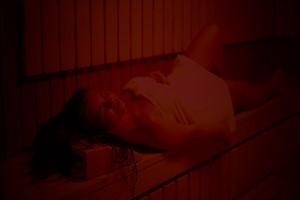
We have already discussed the many benefits of infrared cabins (warmth, relaxation, stress reduction, strengthening of the cardiovascular system, reduction of muscle tension, pain reduction, improvement of general well-being, and much more) in detail in the article on "The effect of infrared on health." They are optimally complemented by colored light.
It is therefore advisable to combine infrared cabins with colored light. All our saunas are equipped with colored light, with the Essential and Premier series containing our standard colored light with 15 LEDs and 6 colors, while the Sanctuary series comes with the intensive colored light option with 96 LEDs and 12 colors. The intensive colored light can be purchased as an upgrade in the Essential and Premier series.
This way, in addition to the infrared sauna, you can enjoy the many positive effects of colored light – all in one session. The intensive colored light lamps with 96 LEDs for the infrared sauna can be controlled with a remote control.
You can either individually select the colors your body and psyche currently need, or set the automatic mode, which cycles through all colors sequentially.
Conclusion
Light in its spectral colors can positively influence your health and has proven diverse effects on body, psyche, and mind. These effects include both relaxation and activation, both improved relaxation and increased well-being, both increased motivation and improved memory performance.
You can best take advantage of the thousands-of-years-old successful colored light in combination with a beneficial stay in an infrared sauna.
Sources
[1]
Paragas, Emmanuel D. et al. Effects of Chromotherapy on the Cognitive Ability of Older Adults: A Quasi-Experimental Study. Explore (NY). May-Jun 2019;15(3):191-197.
Abstract: https://pubmed.ncbi.nlm.nih.gov/30718190/
[2]
Yousuf, Samina T. et al. A Critical Analysis of Chromotherapy and Its Scientific Evolution. Evid Based Complement Alternat Med. 2005 Dec;2(4):481-488.
https://www.ncbi.nlm.nih.gov/pmc/articles/PMC1297510/pdf/neh137.pdf
[3]
Yousuf Azeemi, Samina T. et al. The mechanistic basis of chromotherapy: Current knowledge and future perspectives. Complement Ther Med. 2019 Oct;46:217-222
Abstract: https://pubmed.ncbi.nlm.nih.gov/31519282/
[4]
https://www.lichtmikroskop.net/optik/lichtspektrum.php
[5]
Jonauskaite, Domicele et al. To see or not to see: Importance of color perception to color therapy. Color research and application. 2020-06, Vol.45 (3), p.450-464.
Abstract: https://onlinelibrary.wiley.com/doi/abs/10.1002/col.22490
[6]
Aktekın, Denız Başbinar et al. A New Model for Chromotherapy Application. Color research and application. 2012-04, Vol.37 (2), p.154-156
Abstract: https://onlinelibrary.wiley.com/doi/abs/10.1002/col.20658
[7]
O'Connor, Zena. Colour Psychology and Colour Therapy: Caveat Emptor. Color research and application. 2011-06, Vol.36 (3), p.229-234
Abstract: https://onlinelibrary.wiley.com/doi/abs/10.1002/col.20597
[8]
Pogonchenkova, I.V. et al. [To the question of the possibility of using selective chromotherapy for allergic diseases in children]. Vopr Kurortol Fizioter Lech Fiz Kult. 2020;97(4):37-43.
Abstract: https://pubmed.ncbi.nlm.nih.gov/32687299/
[9]
Wills, Pauline. Colour healing manual: the complete colour therapy programme. Singing Dragon; 2013.
[10]
Yadav, Anju et al. Noninvasive red and near-infrared wavelength-induced photobiomodulation: promoting impaired cutaneous wound healing. Photodermatol Photoimmunol Photomed. 2017 Jan;33(1):4-13.
Abstract: https://pubmed.ncbi.nlm.nih.gov/27943458/
[11]
Glickman, Gena et al. Light therapy for seasonal affective disorder with blue narrow-band light-emitting diodes (LEDs). Biol Psychiatry. 2006 Mar 15;59(6):502-507.
https://core.ac.uk/download/46966313.pdf
[12]
Dunjic, Momir et al. Stress and colour therapy. European journal of integrative medicine. 2012-09, Vol.4, p.200-200.
[13]
Minguillon, Jesus et al. Blue lighting accelerates post-stress relaxation: Results of a preliminary study. PloS One. 2017 Oct 19;12(10):e0186399.
https://www.ncbi.nlm.nih.gov/pmc/articles/PMC5648169/pdf/pone.0186399.pdf
[15]
https://www.sonnentaler.net/dokumentation/wiss/optik/weiter/spektrum/
[16]
https://scienceblogs.de/astrodicticum-simplex/2012/04/05/es-existiert-kein-rosa-licht/



Share:
HomeDeluxe vs. Clearlight - The Best Infrared Saunas
Easy Ways to Improve Your Cardio Fitness