


When choosing an infrared cabin for your home, experts repeatedly advise paying special attention to the type and quality of the heaters.
In this context, terms such as ceramic heaters, full spectrum, near infrared, or carbon heaters are often mentioned.
But what does all of this actually mean? What should you really look out for? And are carbon heaters truly better than ceramic heaters in an infrared sauna?
Carbon Heaters: The Best Heaters for Your Infrared Cabin?
Carbon heaters are the newer variant of infrared heaters compared to the well-known and proven ceramic heaters, and they are becoming increasingly popular due to their modern technology.
These panel heaters are considered more reliable and robust, which has led to a real hype around the products.
We have taken a closer look at carbon heaters to explain whether they are worth the excitement.
Carbon vs. Ceramic Heaters
Carbon heaters or ceramic heaters? The ultimate question. A short direct comparison will help you identify the differences between the two types of heaters.
Heat Distribution
Carbon heaters in an infrared cabin consist of thin carbon fiber panels and have a uniform heat distribution area. This avoids localized hot spots, which are common with ceramic heaters.
The infrared heat emitted by carbon heaters is evenly distributed throughout the cabin. This leads to more sustainable and intensive warming of the human body, as no part of the body is left out.
If you prefer to warm and radiate individual body parts, such as just your back, a ceramic heater is the better solution for you.
Surface Temperature
The surface temperature of a carbon infrared panel heater is lower than that of ceramic heaters. This makes them safer to touch and also allows for longer sessions in the sauna due to the lower surface temperature.
However, the lower surface temperature is of much more central importance than "just" achieving even and sustainable heating.
The main reason for the popularity of carbon heaters is that they allow for an ideal wavelength profile. It is now known that the human body emits heat with a wavelength of 9.4 μm (micrometers). [1]
Our organism therefore emits infrared heat itself with a wavelength of 9.4 μm. You can easily test this by rubbing both palms together and then holding your hands in front of your face. You can clearly feel the gentle infrared heat in a pleasant way.
This knowledge is used in the design and production of infrared heaters, attempting to adapt the infrared radiation to 9.4 μm for the best possible heat exchange.
Why? Because in physics there is the effect of resonance frequency. This effect occurs at frequencies of the same wavelength, which increases the amplitude of the frequencies.
This in turn leads to a more intensive heat exchange, whereby the infrared heat can be better absorbed by our body, which works with the same wavelength, or converted into thermal heat.
So, when it comes to the design of a heater, it makes perfect sense to adapt the wavelength of the heater to that of the human body, i.e., 9.4μm. This range is primarily emitted by carbon heaters in the Type C infrared range.
Heat Coverage
Heat recovery from infrared cabins with carbon heaters is higher, while the maximum heat from ceramic heaters is directly at the heating elements. The further you sit from them, the less infrared radiation is absorbed.
Therapeutic Infrared Rays
In an infrared cabin with carbon panel heaters, rays are emitted that are closer to far-infrared rays. These are particularly useful for the body's health. This allows you to experience the benefits of the infrared cabin even better.
Operating Hours
The lifespan of carbon panel heaters is incomparably longer than that of punctual ceramic heaters. The difference here is approximately 5,000 hours for ceramic heaters and 20,000 hours of operating time for carbon heaters.
Energy Consumption
Carbon heaters generally consume less electricity than ceramic heaters. However, ceramic heaters heat up faster and therefore require less heating time before using the infrared cabin.
Price
Ceramic heaters are the more affordable option. This also makes the infrared cabin as a whole somewhat more affordable.
It's the Mixture That Matters
Thanks to ceramics' high thermal conductivity, it is one of the best conducting materials on the market. It absorbs and radiates infrared waves more strongly than any other material.
However, the longevity and pleasantly distributed heat of carbon heaters are equally popular.
Those who can't decide between an infrared cabin with carbon heaters or an infrared sauna with ceramic heaters can opt for popular combination products.
The True Wave II™ far infrared heater from Clearlight is a carbon-ceramic hybrid infrared heater that combines the best of both worlds. This technology is patented and currently the only carbon and ceramic heater worldwide.
The carbon ensures long-wave infrared light, largely in the 9.4μm range, known for its deep penetration. Additionally, these hybrid infrared heaters have a low surface temperature, allowing them to be installed all around the infrared cabin and radiate the body optimally from all sides.
The ceramic component in the heater ensures high efficiency, as it allows for more intense infrared radiation to be emitted than with pure carbon heaters.
This combination also boasts a longer lifespan for the heater: On average, these heaters achieve approximately 25,000-30,000 operating hours, an enormously long durability thanks to high production standards, strict quality requirements, and an innovative concept.
So, if you can't decide, this product is highly recommended.
How Infrared Heaters Work
Infrared heaters work by converting electricity into radiant heat. This means that the heater is supplied with electrical energy, which it then converts into infrared radiation. However, heat is only generated when these rays hit a solid object.
Infrared is part of the electromagnetic spectrum. This optical heat radiation covers a wavelength range from 780 nanometers to 1 millimeter. Due to this wavelength, the radiation is not visible to the human eye.
We perceive infrared as heat. The largest naturally occurring source of infrared radiation is the sun. And in fact, every body with a temperature above absolute zero emits infrared radiation.
But back to infrared heaters. There are 3 different types of infrared, and not every heater emits the same type of radiation.
- Infrared A: 780 to 1400 nm = short-wave infrared radiation
- Infrared B: 1400 to 3000 nm = medium-wave infrared radiation
- Infrared C: over 3000 nm = long-wave infrared radiation
Long-wave rays do not penetrate as deeply into the skin, but mainly warm the uppermost skin layer. This means that you do not perceive this heat as intensely, and the healing effect is less or only sets in after prolonged radiation.
Short-wave rays penetrate much deeper into the skin. But don't worry, this is by no means dangerous. On the contrary, the effect of infrared-A radiation is absorbed more quickly and effectively by the body, and you perceive it more intensely. [2]
The Different Types of Infrared Heaters
Just as there are different types of radiation, there are also different types of heaters for your sauna. Essentially, a distinction is made between tube heaters and panel heaters. But more on that in a moment:
- Tube Heaters
Tube heaters, also known as ceramic heaters, heat ceramic rods until they glow red. This means these heaters are spot-heating emitters and primarily operate in the infrared-B and infrared-C radiation range.
The infrared radiation generated by them has a very high intensity. The radiation feels very hot and localized and does not penetrate as deeply as that of a full-spectrum heater.
Ceramic heaters are known for quickly generating large amounts of heat in specific spots, which is why infrared cabins with this type of heater become very hot very quickly. This, in turn, is not the goal of a good infrared cabin, which is about infrared radiation and not hot air.
This localized heat can hardly heat an entire infrared cabin in an energy-efficient way.
They are therefore more suitable for targeted radiation of small body parts rather than providing an entire heat cabin with infrared radiation.
Tube heaters are comparatively inexpensive to purchase, but they also have a shorter lifespan.
- Magnesium Heaters
Like ceramic heaters, magnesium heaters are considered spot heaters. Here, too, the wavelengths are in the B and C range.
However, unlike ceramic heaters, magnesium heaters do not only emit radiation punctually, but also heat the surroundings somewhat more efficiently.
This means they function not only as spot heaters, but also as panel heaters.
The heat- and moisture-resistant stainless steel from which the tubes are made are considered more robust than ceramic tubes.
- Panel Heaters
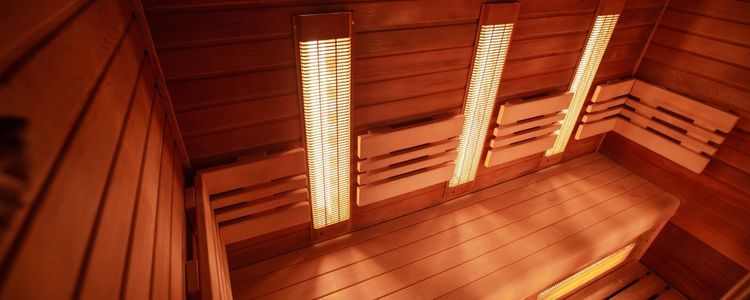
Panel heaters, also known as carbon heaters, generate long-wave infrared heat in the infrared cabin. This means we are talking about far-infrared, which we as humans perceive with less intense heat. Good panel heaters, like the TrueWave™ heaters, also generate a portion in the infrared-B range.
The gentle, yet strong heat is evenly distributed in the infrared sauna and ensures a uniform heat impact on the body.
Unlike ceramic heaters, carbon panel heaters get less hot on the surface. This means there is no risk of burns.
Due to the smaller surface area, these infrared heaters generate a pleasant and gentle infrared, which is ideal for the human body.
The disadvantage is often that the infrared heaters extend up to the ceiling so that the infrared cabin reaches temperature. This contradicts the warming of the human body.
The large-area effect of these heaters is excellent for heat cabins, but it also comes at a price.
Panel heaters are generally more expensive than tube heaters. However, they are also known for their robust functionality and longevity.
- Full Spectrum Heaters
As the name suggests, these heaters produce the full spectrum of infrared radiation: long-wave, medium-wave, and short-wave infrared radiation.
Full-spectrum heaters are therefore the most expensive, but also the most versatile heaters. Hardly any other infrared heater has such an intensive, all-round effect on the human body as this one.
However, some people find the intensity of full-spectrum heaters almost too high, which is why long sauna sessions are not recommended.
At Clearlight, we have therefore incorporated various intensity levels: You can regulate the intensity to 50%, 75%, and 100%, thus choosing the settings you prefer.
What to Look for in Infrared Heaters
To make buying your infrared cabin easier, we've put together a checklist of the top 5 things to consider regarding infrared heaters.
- Type of Infrared Heat
Infrared heaters can emit near, medium, far, and full-spectrum infrared heat. You already know the facts. The choice is ultimately yours.
- Heater Material
Ceramic and carbon are the most commonly used materials for infrared heaters. You should not only consider the price but also the heat distribution, type of infrared radiation, and longevity.
Whether a ceramic heater or a carbon heater is better for your needs is up to you to decide.
- Heater Safety
In any case, pay attention to the electromagnetic field values. EMFs are electromagnetic frequencies that can potentially lead to restlessness, headaches, or even an increased risk of cancer. [3]
That's why all Clearlight models are characterized by the lowest EMF values on the market. The True Wave™ far-infrared and full-spectrum infrared heaters have far fewer to no such energy waves and are therefore absolutely harmless to use.
- Surface Temperature
For optimal effectiveness, you should choose an infrared sauna with a heater that has a lower surface temperature. This not only reduces the risk of burns when touching the heater but also ensures balanced, even heat in the cabin.
As described above, the wavelength range should be around 9.4 μm to achieve gentle, sustainable, and intensive heat transfer thanks to the "resonance frequency" effect.
This wavelength lies in the range of 9.4 μm. So, if it is claimed that a large proportion should be in the infrared-B range, then this concept of heat exchange or frequency theory is completely ignored. Therefore, we encourage you to truly understand this topic. We are also happy to help with answers.
- Placement of Heating Elements
Ensure that your infrared sauna has heaters all around you. Ideally, the heaters should be placed on the back wall, side walls, under the bench, at the calves, and on the floor so that you are completely surrounded by infrared heat.
We like to refer to this as 360° heat supply, so that your body can be warmed sustainably and holistically.
This effect can best be achieved with carbon and ceramic heaters. These have a large surface area, a good wavelength profile, and ensure that no part of your body remains cold.
This is not technically feasible with pure ceramic heaters, or tube heaters in general, as these require a distance from the body and the next heater.
Due to the high temperature and thermal conductivity, these heaters are installed at a greater distance from the body, as the risk of superficial burns would otherwise be too high.
If you consider these tips when buying your infrared cabin or infrared heater, nothing can really go wrong.
If you would like to know more about infrared cabins, we at Clearlight are happy to advise you.





Share:
HomeDeluxe vs. Clearlight - The Best Infrared Saunas
Easy Ways to Improve Your Cardio Fitness